Bitcoin Fusion Breakdown No. 1
The Trojan Horse
How Cardone Capital Turns Apartment Buildings into Amplified Bitcoin

Arben Gutierrez-Bujari
Founder and CEO, Pyrus Financial · September 15, 2026 · 13 min read
Independent analysis. The author is not affiliated with Cardone Capital or Grant Cardone and holds no position in any Cardone fund. Full disclosure at the end.
Grant Cardone, via Cardone Capital, is running one of the most innovative new fund structures in private real estate. After having personally spoken to several private investor real estate fund managers, it's clear that no one else is prepared to take such an innovative and committed step as Cardone Capital.
Now, many of them have heard that Cardone Capital is doing these Bitcoin fusion funds yet haven't put in any of the time or homework to understand the structures and the reason why Cardone Capital is running these funds.
For some standardization and efficiency's sake, we're going to take a few assumptions in this analysis. By the end of reading this you'll fully understand why Cardone Capital has put together five of these funds, with more in the pipeline and is on target to put together ten and then roll it into a public equity.
The next section is context on how a traditional private real estate fund is built, for anyone who isn't already fluent in the capital stack. If you are, or if you're Grant, skip ahead to “Where Cardone Capital Breaks From the Stack.”
How the Traditional Stack Works
These are the assumptions we'll be looking at:
- Large multi-family real estate properties, anywhere between $50 million and $500 million in a Class A multi-family property fund.
- Traditionally these funds are structured with several layers of capital, and by seniority.
- At the top lives the debt utilized to acquire the property.
- Under that, it's common to see a preferred equity or mezz sliver, often funded in-house by an affiliate private credit fund of the fund management team itself. It gets a fixed coupon, gets paid second, and has no share of the additional upside. Think of it as a second loan wearing an equity costume.
- Below that lives common equity, which is paid last.
What's important to understand about these layers is that as the property generates cash flow and makes a return as a whole (both on the net operating income and on the rise in appreciation of the property), this stack dictates who gets paid, in what order, and how much.
Those at the top, the loans, get paid what the loan documents state, which is principal plus interest. Below that the preferred equity or mezz sliver gets paid, often at a slightly higher rate than the bank loan does, to the private credit investors funding it. This is a separate share class with a fixed return, no promote, and no additional upside. It behaves like a loan, not like ownership. The common gets paid last, and it holds a preferred return hurdle, where the target return is the right of the investors and anything above it is split with the management sponsor of the fund.
One more thing to keep straight, because it matters for everything below: preferred equity and preferred return are two different things. Preferred equity is a layer in the stack, senior to common, with a fixed coupon and no share of the upside. Preferred return is a defined earnings hurdle inside the common layer: the first 8% or so goes to the investors, and everything above it splits with the sponsor. The Bitcoin sleeve sits entirely in the common, so the debt holders get none of the Bitcoin upside and the preferred equity holders get none either. All of it lands entirely on the common, which is in part why the amplification numbers for the common and for the promote get so large.
With this context in mind you can start to see where the earnings of a well-run acquisition, management, improvement, and exit for these multi-family real estate properties are distributed.
Now there are two sides in these deals: there are the investors in the funds and there is the fund manager. We'll take a look at both sides and how their earnings change significantly with the Bitcoin fusion component.
To be even more precise we're going to focus on the common equity sliver in these deals, which in traditional structures is roughly the bottom 15% to 20% (sometimes even up to 40%) portion of the capital stack.
The reason for this is that the two upper portions, the bank debt and the preferred equity or mezz sliver, often have a fixed return rate due to their earnings relying purely on interest. Sometimes the credit firm sliver has active payouts at one level of return and target/exit fund accumulated returns at a second level. For example they might pay their private credit firms 8% monthly yet have an accumulated interest income of 10%, deferring the accumulated accrued amount payment at fund close/exit.
These Bitcoin fusion real estate funds allow the most junior capital in the stack (the common equity) the greatest upside and of course as Bitcoin appreciates and the fund performs, it minimizes the risk for those above.
Where Cardone Capital Breaks From the Stack
Now that we went over the traditional stack, the first important thing to realize is that Cardone Capital's own funds have a differing structure to this traditional stack, and it's key to understand this before we add the Bitcoin component.
Where the traditional private real estate equity fund layers on the bank loan, the mezz or preferred equity sliver, and then the fund's common at the very bottom, Cardone Capital utilizes a treasury of its own funds, its own cash, to essentially acquire these deals in whole with no debt. That gets rid of the top of the stack entirely and simplifies the capital structure down to solely the fund itself. There is less distributed leverage, fewer layers of seniority, and from day one the fund holders are provided direct exposure to the entire property, not just the most junior sliver of it.
This is made possible by one simple thing: Cardone Capital has a lot of cash. Much more cash than most of these traditional private real estate funds do. It is also worthy to mention, Grant's vast media presence provides him the ability to raise enough capital from private investors to fund entire properties, not just a portion of them.
Why is this all cash purchasing advantageous? Because it gives Cardone Capital (and by proxy its fund investors) the flexibility to refinance or access loans completely at their own discretion. Having all of that done while the fund already owns the property gives them all the leverage to negotiate and shop around for the best rates and the best financing, and it negates the complexity and the loss of negotiating leverage present when you're trying to close on a property with loans and all of these capital players in the stack at the same time. They get to navigate options driven by the market, driven by the available loan offers, and driven by the financing, on their own timeline.
And when they do choose to execute on that financing, it creates an intra-fund liquidity event. During the life and duration of the fund there is a large release of capital, which they can use to pay investors back a significant, double digit, sometimes even greater than 50% as we've seen them do, percentage of their principal. Notably these funds sent back to investors are also tax-deferred, as they are categorized as a “return of capital.” This action essentially backs the investors into the traditional fund structure but having done so with far greater flexibility. The larger equity position up front is in part what enables stronger confidence in the ability for Cardone Capital to pay investors back a large portion of their principal in the early years of the fund. When announced, these events also serve Cardone Capital as public “proof” of their management success.
Other management companies will layer on loans and mezzanine and preferred equity layers up front and put the fund holders at the most junior position. That creates complexity and pushes all of the initial risk of the property down onto the common shareholders. With Grant Cardone, from day one he grants them exposure to the entire thing and then backs them into their position thoughtfully, in full control of what financing they take, when they take it, how they take it, and at what rates.
Now, Cardone Capital's Bitcoin Fusion Funds will target the acquisition of a property much like everybody else in the market. They try to get the best property at the best deal.
Two things have to be true for any of these deals to work: the property gets bought below replacement cost, and it throws off strong net positive cash flow. Everything else is built on top of those two.
Take replacement cost first. It is a very intentional term. It is the dollar amount for what it would cost to build that property, in that location, today, factoring in construction costs, interest rates, the land, and the uniqueness of the site. It is a generous valuation, often higher than what a traditional appraiser would assign, which is exactly why these funds like to quote it. Buying below replacement cost is how they further showcase their ability to get the best deal, and the delta between purchase price and replacement cost is what they expect (in theory) to capture at exit. It gives them a stronger hand when the property eventually sells. That is the base competency.
The second is NOI, net operating income, which really just comes down to cash flow. Unlike the purchase price, NOI is something the manager can keep improving for the entire life of the property: tasteful small renovations, better landscaping, a better tenant experience, higher rents, higher occupancy. Can the fund manager grow the cash flow of the asset while they own it? That question is the other half of the business.
Now Add the Bitcoin
Up to this point, much of this article has covered the same facts and goals of traditional real estate funds, so let's now add in the Bitcoin component. Grant (Cardone Capital) is utilizing the difference between their purchase price and the stated replacement cost of a property to fund a Bitcoin purchase. For example, if a property's replacement value in a prime spot in Florida is $100 million, and Cardone Capital's fund is able to acquire the property for $80 million, Cardone Capital will raise the $100 million and put that delta, the $20 million, into a Bitcoin purchase. Rather than raising the amount of capital necessary for purchasing the property at the purchase price they get, they raise the replacement cost amount of capital. Now this Bitcoin sleeve lives alongside the real estate asset itself within the fund to juice common shareholder upside.
This dual-asset structure is what puts these funds in the Bitcoin fusion category. Bitcoin gets fused into a traditional capital structure, and the fund pulls the benefits of both: the strength, leverage, and cash flow the real estate side already offers, and the upside the Bitcoin side brings.
Grant's first deals started at roughly 15% Bitcoin and 85% real estate in terms of the composition of these funds. He has since offered several other funds that vary all the way up to a more aggressive balance of 30% Bitcoin and 70% property.
Now let's talk about the effects of doing this.
First off, the traditional side is still doing what it always does. The stability comes from buying the property at a good price and growing NOI over the hold, and because the majority of the fund is the real estate asset, fueled by rents and the eventual capture at exit, investors keep that stability. The one caveat is that they will be junior on the stack once the property is refinanced, which is standard practice.
At 15-30%, the Bitcoin is a minority of the fund, and because Cardone is acquiring the whole property all cash, that is 15% to 30% of the entire capitalization, with the real estate making up the other 70% to 85% and no debt sitting on top of it. Day one, this looks like a real estate fund with a Bitcoin position.
Now watch what happens at the refinance. The debt comes in against the property and the Bitcoin stays untouched. On a $150 million fund with $30 million of Bitcoin, refinancing the property at 60% loan-to-value returns roughly $72 million to investors and leaves $78 million of equity in the fund, $30 million of which is Bitcoin. The allocation just went from 20% of the fund to close to 40% of the remaining equity without buying another coin. That is the mechanism, and it's why the small-looking sleeve ends up carrying so much of the fund's return.
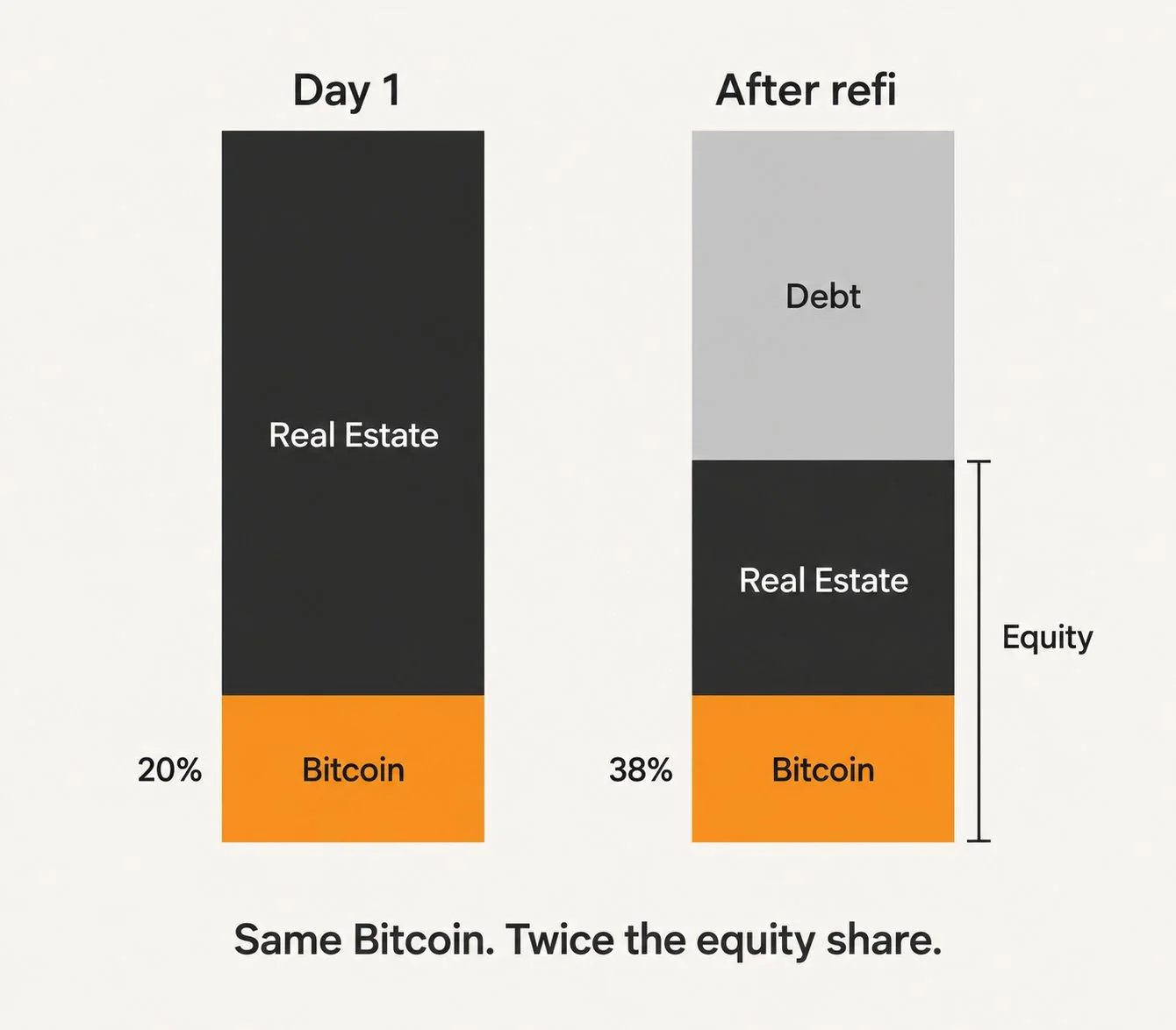
This is also why the unique all-cash acquisition and over-sized fund sizing is so key. The Bitcoin has the room it needs, both numerically and timewise, to experience and display the dollar-denominated volatility that is expected of the asset, while the fund still retains the strength of a traditional real estate fund's makeup.
The power of this Bitcoin sleeve shows up when Bitcoin keeps doing what it has done historically. Over any 7 to 10 year window ending today, Bitcoin's annualized return has run between roughly 33% and 60%. Even the worst recent window, the five years from the 2021 peak to today with Bitcoin sitting 38% below its all-time high, still annualizes at about 10%, which clears an 8% preferred return. The sleeve does not need Bitcoin's best decade to work. It needs Bitcoin to keep clearing the hurdle. For a single reference BTC's 8-year CAGR is ~35%.
By “power” I mean the juice on returns, and it lands on both sides of the table: the private investors and the fund manager, Cardone Capital in this case. The mechanism is simple. Cardone Capital's fusion funds carry roughly an 8% preferred return. Below that number, every dollar goes to the investors. Above it, the returns are split between the investors and the manager as a promote. So once the Bitcoin sleeve clears 8%, which at any of the historical rates above it does with room to spare, it starts feeding the promote directly.
We hear Grant Cardone discussing a highly aggressive 50/50 split on promote in several podcasts. More common splits in private real estate is 20/80 or, in some aggressive management cases, 35/65. Much of this promote split depends on how much the manager is charging for other fees, like acquisition, loan closure, and a floating management fee of total asset values or total fund size. Those earnings above the preferred return are where both parties get paid for the risk they take. The private investors take the risk of being positioned as the most junior on the stack, and Cardone Capital manages the entire deal taking on the operational and financial risk of these funds. They get paid handsomely for it.
In traditional real estate deals like this, this hurdle is surpassed by executing the two traditional levers: increased NOI and net appreciation of the property. In these Bitcoin Fusion cases, there is now a third component: Bitcoin's performance. Once Bitcoin passes that preferred rate of 8%, Cardone Capital's offering is well structured to receive tons of upside from there on.
While fund managers are well deserving of earning a promote share above a preferred return to their investors, Cardone Capital is able to demand a larger portion of this promote due to the fact that they are essentially the only player in this Bitcoin fusion model. This is why I highlight the enablement of a 50/50 split on returns above the preferred return. To be clear, the 50/50 is what he is talking about for the next funds. The example below uses the 35% that is actually in the filed documents for several of Cardone Capital's existing funds.
The Amplification Math
I'd like to focus on Cardone Capital's return in one of these situations and speak about a term that more Bitcoin-focused investors are well familiar with: the Bitcoin amplification, or the multiple of Bitcoin exposure on one's contributed equity. Cardone Capital sits at the best seat at this table.
If you go to strategy.com and look at Strategy's numbers for Bitcoin amplification or other Bitcoin treasury companies like Strive, it is common that you'll see a number between 1 and 1.5 in terms of Bitcoin amplification. Cardone Capital's structure is one of the few where we see 5x up to 10x+ Bitcoin amplification. This is the real edge that these fund structures provide.
Let's take the example of a $150 million fund that Cardone Capital put together. Grant Cardone personally co-invests in these deals alongside the fund; his own SEC filings state that he typically holds 1% to 2.5% of each property-owning LLC. On a fund of this size that is roughly $1.5 million to $3.75 million of his own equity, and in one deal of similar size the figure on record was $1.8 million. Meanwhile his management company, which he wholly owns, holds the promote above the preferred return.
Now, this $150 million fund: say the fund raised to the property's replacement cost and acquired the property for ~$120 million, leaving a $30 million delta, or 20%, that went into Bitcoin (the real numbers vary slightly, we are simplifying to focus on the amplification mechanism). Let's assume the property alone is able to meet its portion of the preferred return. Once Bitcoin hits the preferred return, anything above it, he has 35% exposure to the upside earnings. So his management of this fund effectively granted his $1.8 million of equity exposure to 35% of a $30 million Bitcoin position, which is $10.5 million of Bitcoin. That is a 5.83x Bitcoin amplification of his $1.8 million equity contribution. Granted, only the returns above 8% count, but for Bitcoin that is still most of it. Assuming a 32% return on Bitcoin, he still captures roughly 75% of the upside, which realistically brings his Bitcoin amplification closer to 4.4x. Still an extremely advantageous position, and far better than the amplification common equity holders of treasury companies have access to.
Two more things fall out of the fund refi. First, it does not touch the Bitcoin, so his exposure on the $30 million position is the same the day after as the day before. Second, by the time they place that loan in the stack and pay investors back early, the Bitcoin may have appreciated greatly. That makes the financing of that property and the introduction of a more senior debt holder even more attractive, with better rates and better terms than they would have gotten if they had layered on the debt out of the gate while acquiring the property.
When I briefly spoke to Grant about this on an X spaces, he talked about the real estate being the “Trojan horse,” and he's right. The scale of these real estate funds, the makeup of private investors, his massive media machine and the track record of his multi-decade performance, along with his operational ability to execute these funds, have provided him with a very unique way to access amplified Bitcoin exposure without any liquidation risk. The structure greatly dampens the volatility of Bitcoin and minimizes pressure that pure-Bitcoin structures are exposed to in down markets, which, to me, is a dream scenario for many of the investors allocating in this space.
One of the unique elements that is not to be ignored is the sheer size of these deals. The Boca Raton fund alone is roughly $335 million, a $235 million property paired with $100 million of Bitcoin, and his newest Bitcoin Fusion fund in Fort Lauderdale was reported at around 2,000 apartment units and roughly $600 million of real estate paired with 900 to 1,200 BTC, a single vehicle approaching $700 million. Two funds and he is already past $1 billion. His stated end goal is ten of these funds holding ~15,000 apartment units and ~10,000 Bitcoin, which at today's prices is well north of $3 billion of AUM. At that scale he intends to restructure and refinance, package the Bitcoin Fusion funds into one public equity, and layer senior and junior tranches of that equity onto the public markets, opening up a tremendous amount of capital for the scaling and continuation of this fund structure.
I personally find his innovative approach bold, and I think most people underestimate just how impressive his commitment to these structures is. It is what singles out Grant Cardone as a trailblazer in this case and puts him far ahead of the pack.
No other private multifamily fund manager is operating on this bleeding edge like Grant is. Most of them dress up their ignorance of these structures as conservatism: they aren't interested, they haven't done the homework, and more than a few laugh at the idea. Personally, I think that's irresponsible. It will be a lot harder to laugh when these fund structures are absorbing billions in AUM and pulling LPs out of their offerings and into Cardone's.
This is not a prediction, it's what I personally found. I went and talked to the sponsors who could be doing this, and not one of them has started. Grant Cardone isn't just the market leader and the market first. Right now he is the entire market, and I expect him to own it for a long time.
Disclosure
Many of the figures in this article are illustrative. Fund sizes, allocation percentages, promote splits, and the amplification math are simplified for the purpose of explaining the mechanism and are not taken from Cardone Capital's offering documents unless a source is cited. Arben Gutierrez-Bujari and Pyrus Financial are not investors in any Cardone Capital fund and are not affiliated with Cardone Capital or Grant Cardone in any way. The author's exchange with Grant Cardone referenced in this article took place on a public, recorded X Spaces with more than 600 live listeners. Pyrus Financial does build and evaluate Bitcoin-fused financing structures of its own, in consumer lending and in adjacent markets and readers should weigh this analysis with that in mind. Everything here is the author's private opinion, thinking, and analysis. It is not investment advice, and it is not an offer or solicitation of any security.
About the author
Arben Gutierrez-Bujari is the founder and CEO of Pyrus Financial, a Bitcoin-native private credit firm, and one of the earliest practitioners of the Bitcoin fusion model: fusing Bitcoin into traditional financial structures so they keep the strength, leverage, and cash flow they already have and gain Bitcoin's upside on top. He follows and analyzes Bitcoin Fusion structures across markets, from consumer lending to private real estate. He is trilingual, an alumnus of Pepperdine University, Chico State University, and American River College having studied and received degrees in computer science and business management.
About Pyrus Financial
Pyrus Financial is a Bitcoin-native private credit firm building the fusion of Bitcoin and traditional consumer lending. Its core product, the Bitcoin Equity Loan, is a USD installment loan underwritten on the borrower's income and creditworthiness where the proceeds fund a Bitcoin purchase pledged as supplemental collateral. Pyrus is also exploring Bitcoin amplification opportunities in adjacent markets, including private real estate. The firm has received funding from top venture capital firms including Draper Associates, Draper Dragon, and Plan B Fund.


